Every article about Bizen ware says the same thing: no two pieces are alike, and the fire decides. Both are true. Neither is an explanation.
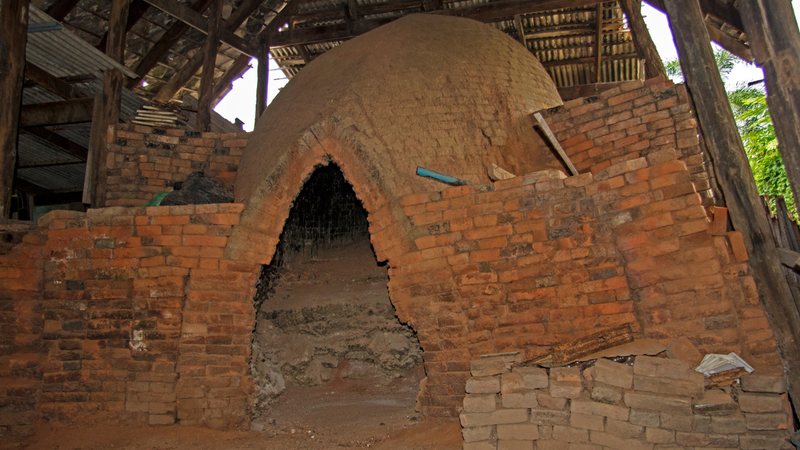
The fire is not making arbitrary choices. It behaves the way fire behaves — heat rises, ash falls, flame follows the draught, and buried things starve of oxygen. A Bizen kiln is a large chamber in which all of that happens in a predictable pattern, and the potter knows the pattern. What looks like an accident is very largely a matter of where in the kiln a pot was standing, and deciding that is the part of the craft nobody photographs.
→ This is the making side. For what Bizen is, how it feels to drink from, and how to look after one, start with Bizen ware: the unglazed clay cup that grows with you.
Why There Is No Glaze
Glaze does two jobs on most pottery. It seals a porous body so it holds liquid, and it decorates. Bizen needs neither.
The reason is the clay. Bizen is made from hiyose (田土) — literally “paddy soil” — dug from a layer several metres beneath the rice fields around Inbe, in Okayama. It is fine-grained, unusually plastic, and heavy with iron. Fired hard enough and long enough, a clay like that vitrifies on its own: the particles fuse into something dense and water-tight without any coating at all.
That technique has a name in Japanese, yakishime (焼き締め) — roughly, “fired tight.” It is the oldest way of making a watertight pot and it predates glaze entirely. Bizen never adopted glaze not because potters there were conservative, but because the local clay made it unnecessary.
There is a cost. Hiyose is plastic enough to throw beautifully but has poor heat resistance, and it shrinks a great deal as it dries and again as it fires. Push the temperature too fast and pieces crack, slump or split outright. This is the whole reason a Bizen firing takes a fortnight rather than a day. The long firing is not a ritual. It is what this particular clay requires in order to survive.
The clay is also aged before use — dug, left to weather in the open, then stored, often for years. Weathering breaks the particles down further and makes the body more workable. Some Inbe workshops are still using clay their grandparents dug.
Two Weeks of Red Pine
The kiln is loaded, sealed, lit, and then fed continuously for ten to fourteen days, day and night, in shifts. The temperature climbs slowly to around 1,200–1,300°C and is held there before an equally slow cooling that takes several more days.
The fuel is red pine, and the choice is not sentimental. Red pine is resinous, so it burns with a long reaching flame that travels deep into the chamber rather than stopping at the firebox. And its ash is high in the minerals that will, at that temperature, melt into glass.
That last point is the one to hold on to, because it explains almost everything that follows. Over a fortnight, several tonnes of wood become ash, and that ash lands on the pots and melts. Bizen has no applied glaze, but by the end of the firing much of it is wearing one — delivered by the fire, unevenly, according to where each piece stood.
The Marks the Fire Leaves, and How Each One Happens
Bizen's surface effects are collectively yohen (窯変), “kiln change.” The traditional list varies between sources, but these are the ones you will meet, each with a physical cause.
Goma (胡麻, “sesame”) — pine ash settling on the upward-facing surfaces and melting into pale gold droplets. Heaviest on the shoulder of a pot and on the side that faced the firemouth. Where the ash lies thick enough it runs, and you get a genuine glassy flow. Goma tells you which way the piece was facing.
Hidasuki (緋襷, “scarlet cord”) — the red-brown lines that look like ribbon wrapped around a pale body. They are ribbon: rice straw, wound round the pot before firing. Straw is rich in alkali, and where it burns against iron-bearing clay the two react and fix a scarlet line into the surface. The practice began as a way of stopping stacked pots from fusing to each other. Someone noticed the marks were beautiful and it became a technique. Hidasuki pieces are usually fired inside a saya, a protective box, which is why they stay pale — no ash reaches them at all.
Sangiri (桟切り) — grey, blue-grey and near-black passages, sometimes with startlingly sharp edges. These come from pieces sitting low in the kiln, partly buried in ash and embers. Buried, they are starved of oxygen, and iron in an oxygen-starved fire goes dark instead of red. The sharp boundary is simply the ash line.
Botamochi (牡丹餅, “rice cake”) — a round pale disc on a darker surface. Something was resting there: another pot, or a small clay pad placed deliberately. It shielded that patch from ash and flame, and the shape of the shield is what you see. It is a shadow.
Ao-bizen (青備前) — a whole piece in cool blue-grey rather than red-brown, from sustained heavy reduction. Hard to achieve on purpose and correspondingly prized.
Hi-iro (緋色, “flame colour”) — the orange blush where flame licked the clay directly without much ash.
Read that list again and notice what it is. It is not six decorative styles. It is six positions in a kiln. Facing the fire, buried in embers, boxed away from ash, shielded by a neighbour, deep in the reduction zone. The names describe locations.
The Real Skill Is Loading the Kiln
If the marks come from position, then the decisions that matter are made before the fire is lit.
Kamazume — loading the kiln — takes days. The potter is placing hundreds of pieces knowing roughly what each zone does: this shelf will take heavy ash, this corner will stay starved, this piece will shield that one and leave a mark on it. Pots are stacked, propped, wrapped, boxed and deliberately leaned against each other. Every one of those choices is a prediction about how a fortnight of fire will move through the chamber.
So the honest description of Bizen is not that the potter surrenders to the fire. The potter sets the conditions and then genuinely cannot dictate the outcome. Those are different things. A gambler and a farmer both depend on things outside their control, but only one of them chose where to plant.
This also explains the survival rate. You will read that only about three pieces in ten come out of a Bizen kiln as the potter hoped, and the reasons are mundane: cracking as the clay shrinks, warping under its own weight at temperature, ash landing too thick and running where it should not, pieces fusing to their neighbours, or simply an area of the kiln behaving differently from last time. A firing is roughly two weeks of fuel and months of work, resolved once.
Why Two Bizen Pieces Are Never the Same
Because two pieces cannot occupy the same place in the kiln.
That sentence is the whole answer and it is worth being plain about it, because the alternative explanations that circulate in English — the spirit of the fire, the will of the kiln — are lovely and tell you nothing. Two pots a hand's width apart get different amounts of ash, different draught, different oxygen, and are shielded by different neighbours. Multiply that across a chamber the size of a room, over fourteen days, and identical results are not merely unlikely. They are impossible.
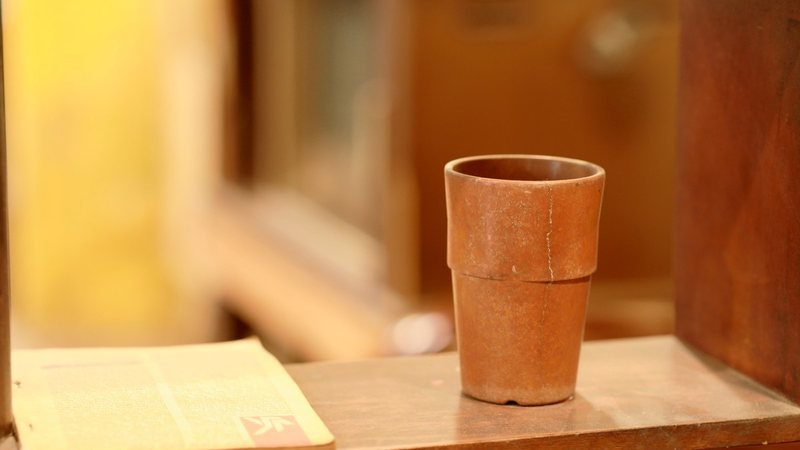
Which means when you pick up a Bizen cup, the marks on it are readable. The darker side faced the fire. The pale circle had something resting on it. The scarlet lines were straw. You are looking at a diagram of a fortnight.
An Acupuncturist's View: Setting Conditions, Not Outcomes
I grew up half an hour from these kilns, so I want to be careful not to sentimentalise them. But the loading of a Bizen kiln is the closest thing I know to what I actually do. I can tell you precisely what I am doing and why — which structure, which direction, what I expect it to change. What I cannot tell you is exactly what your body will do with it, because that part is not mine. Every treatment plan I make is a prediction about a system I do not control, based on knowing how that system usually behaves. The potter placing a pot on the third shelf is doing the same arithmetic. That is not mysticism and it is not a failure of rigour. It is what working with a living thing, or a fire, honestly looks like.
What to Look at Next Time
Pick up any Bizen piece and you can usually reconstruct part of its firing.
Find the ash side. Turn it slowly. One face will be darker, glossier, perhaps with pale golden speckling or a run of melted ash. That side faced the flame.
Look at the foot. The base is often left rougher, and it will tell you how the piece stood — sometimes with three small scars where it rested on wads of clay.
Look for a shadow. A clean pale disc, or a straight-edged pale band, means something was in the way.
And if you are choosing one to buy, a suggestion that runs against instinct: do not pick the most evenly marked piece. Even colouring means the piece sat somewhere unremarkable. The ones with a dark side and a light side, an abrupt edge, a run of ash down one flank — those had a more interesting fortnight, and they are the ones you keep noticing on the shelf in ten years' time.
Frequently Asked Questions
Why is Bizen ware not glazed?
Because the clay does not need it. Bizen is made from hiyose, an iron-rich clay dug from beneath the rice fields around Inbe in Okayama, which vitrifies into a dense, watertight body when fired hard and long. This technique is called yakishime, “fired tight,” and it predates glaze. Any gloss you see on a Bizen piece is melted pine ash delivered by the fire, not a coating applied by the potter.
What is hidasuki, and how is it made?
Hidasuki are the scarlet lines that look like cord wound around a pale Bizen piece — and they are cord. Rice straw is wrapped around the pot before firing, and the alkali in the burning straw reacts with iron in the clay to fix a red line into the surface. The pieces are usually fired inside a protective box so no ash reaches them, which is why the background stays pale. The practice began simply as a way of stopping stacked pots from fusing together.
How long is Bizen ware fired for?
Ten to fourteen days of continuous firing, fed with red pine day and night in shifts, reaching around 1,200 to 1,300°C, followed by several more days of slow cooling. The length is not ceremonial — Bizen clay has poor heat resistance and shrinks considerably, so raising the temperature quickly would crack or warp the pieces.
Why is every piece of Bizen ware different?
Because no two pieces can stand in the same place in the kiln. Ash falls unevenly, the draught reaches some areas and not others, buried pieces are starved of oxygen, and every pot shields its neighbours. Over a fortnight in a chamber the size of a room, those differences compound. The markings are not random — each one records a specific position and what happened there.
Is the potter really not in control?
Not of the outcome, but very much of the conditions. Loading a Bizen kiln takes days, and the potter places every piece knowing roughly what each zone of the chamber does — where ash will fall heavily, where the atmosphere will run oxygen-starved, which pot will shield which. It is a set of predictions about a fire that has not been lit yet. Roughly three pieces in ten emerge as hoped.