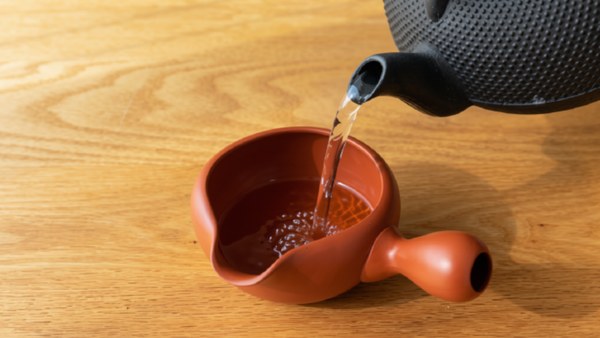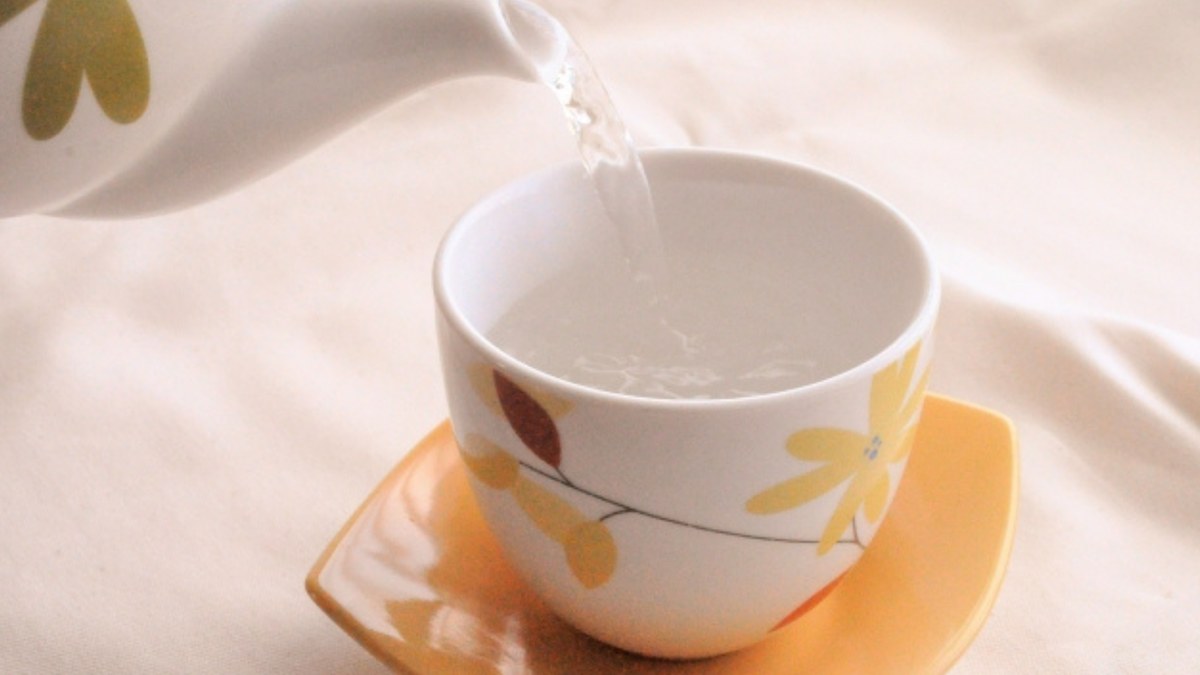
A yuzamashi (湯冷まし) is a small open bowl whose only job is to cool water before it touches the leaf. That is the whole design brief. No lid, no filter, no mechanism. It exists because Japanese green tea is the most temperature-sensitive tea in the world, and boiling water wrecks it.
Most people outside Japan have never seen one, and most people who own one bought it as part of a set without being told what it does. So let me start with the problem it solves, because once that is clear the object explains itself — and you may decide you do not need to buy one at all.
→ Water temperature is the first thing to fix, before the pot and long before the kettle. For where it sits among everything else, see the guide to Japanese tea ware and what to buy in what order.
Why Boiling Water Ruins Japanese Green Tea
Three groups of compounds come out of a green tea leaf, and they do not come out at the same speed.
Catechins are the astringent ones — the dry, puckering edge. Caffeine is bitter. Amino acids, chiefly theanine, are the sweet, savoury, broth-like taste that Japanese tea is prized for and that most Western drinkers have never encountered.
Here is the part that matters: catechins and caffeine extract far faster as the water gets hotter. Amino acids come out steadily even in cool water. So water temperature is not a detail. It is the dial that sets the ratio between sweetness and bitterness.
At 100°C everything comes out at once and the catechins dominate. You get the flat, drying, slightly bitter cup that makes people say they do not like green tea. At 60°C the amino acids come out and much of the catechin stays behind in the leaf. That is why gyokuro brewed at 50°C tastes less like a drink than like a thin, sweet broth.
There is a useful side effect. Because caffeine also extracts more readily in hot water, cooling your water lowers the caffeine in the cup without changing the tea. If you want a green tea in the evening, dropping the temperature is often a better answer than switching to a different leaf.
The Right Temperature, Tea by Tea
These are the temperatures used in Japan. They are not fussy preferences; each one is chosen to sit at the point where that particular leaf gives sweetness before bitterness.
| Tea | Water | Steep |
|---|---|---|
| Gyokuro | 50–60°C | 2–2.5 min |
| High-grade sencha | 60–70°C | 1.5–2 min |
| Everyday sencha | 70–80°C | about 1 min |
| Fukamushi sencha | 70–80°C | 30–40 sec |
| Kukicha | about 80°C | 40 sec |
| Genmaicha | 90–95°C | 30 sec |
| Bancha | 95–100°C | 30 sec |
| Hojicha | 95–100°C | 30 sec |
Notice the pattern at the bottom. The roasted teas — hojicha and bancha — want water straight off the boil. Roasting has already driven off most of the astringency, so there is nothing left for the heat to pull out that you would rather avoid. If you only ever drink hojicha, you do not need a yuzamashi. It is the unroasted green teas that need the help.
What a Yuzamashi Actually Is
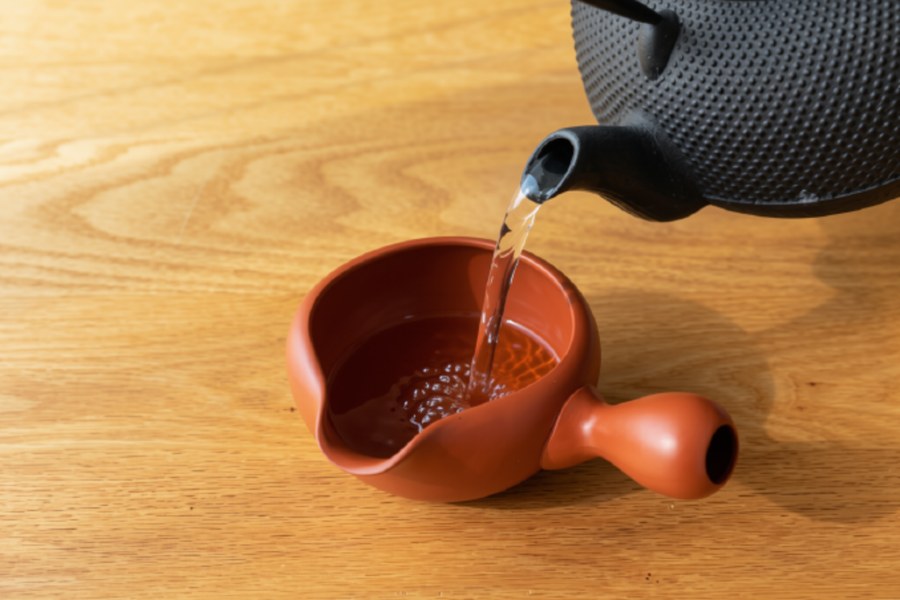
The name is literal: yu is hot water, zamashi is cooling. Every part of the shape follows from that.
It is wide and shallow, because heat leaves through the surface and a wide surface loses it faster. It is open, with no lid, for the same reason. It has a lip or a small spout so it pours cleanly, and often a shallow finger notch rather than a handle, because you are meant to pick it up while it is warm but not hot. Many are simply a katakuchi — a plain pouring bowl — pressed into the role.
It is usually ceramic. Glass ones exist and are pleasant because you can watch the steam settle, but glass holds heat slightly differently and the difference is small enough to ignore. Choose whichever you will actually use.
One thing a yuzamashi is not: it is not a serving pitcher. In Chinese tea practice there is a vessel called a gong dao bei that the brewed tea is poured into so that every cup has the same strength. A yuzamashi can be used that way, and some people do, but its Japanese job comes before brewing, not after.
How Much Does One Pour Actually Cool the Water?
The figure taught in Japan is roughly 5 to 10°C for every vessel the water passes through, with a wide shallow yuzamashi at the upper end of that.
So the standard sequence works out something like this. Water leaves the kettle at 100°C. Into the yuzamashi, and it is around 90°C. Into a room-temperature kyusu, and it is around 80°C — which is exactly where everyday sencha wants to be. Pour into cups first instead, and you land lower still, which is how gyokuro gets down to 60°C without anyone measuring anything.
I want to be honest about that number, though. It is a rule of thumb, not a measurement. How far the temperature actually falls depends on the volume of water, the mass and thickness of the vessel, whether the vessel was warmed beforehand, and how cold the room is. On a winter morning in an unheated Japanese house the drop is much larger than the books suggest.
Which leads to a slightly awkward truth: if what you want is precision, a kitchen thermometer costs less than a yuzamashi and tells you the answer exactly. The yuzamashi is not a measuring instrument. It is a way of building the right habit into the shape of your morning, so that you arrive at roughly the right temperature without thinking about it.
An Acupuncturist's View: Temperature Before Taste
There is a reason to cool your water that has nothing to do with flavour. In 2016 the International Agency for Research on Cancer classified drinking beverages above 65°C as probably carcinogenic to humans, based on evidence linking very hot drinks to cancer of the oesophagus. The mechanism is not chemical, it is thermal — repeated heat injury to the lining, over years. It applies to coffee and soup exactly as much as to tea, and the risk for any one person drinking one hot cup is small. I am not trying to alarm anyone. But this is a habit that costs nothing, takes ten seconds, and improves the tea anyway. In my practice I spend a lot of time persuading people to make small changes with modest benefits, because those are the ones that hold for thirty years. This is one of the easiest I know.
It is worth noticing that Japanese tea practice arrived at the same place from the opposite direction. Nobody in Edo-period Kyoto was thinking about the oesophagus. They cooled the water because hot water made the tea bitter — and built a small object to do it properly. The health argument turned up three hundred years later and agreed.
You Probably Do Not Need to Buy One
Here is the part most guides leave out. Anything that holds water and pours cools water. A yuzamashi is a good version of an idea, not the only version of it.
Pour into your cups first. This is the method I use most, and it is entirely traditional. Fill the cups you are about to drink from, let them stand while you measure the leaf, then pour that water into the kyusu. You have cooled the water and warmed the cups in one movement, and used nothing you did not already own.
Or turn the kettle off early. Many electric kettles now hold a set temperature. If yours does, set it to 80°C and the whole problem disappears.
Or just wait. Boiling water left standing in an open kettle does cool, but slowly and unpredictably, and you cannot tell by looking. Transferring is faster and far more consistent.
If You Do Want One
A few things worth knowing before you choose.
It should hold at least as much as your teapot. A 250ml kyusu wants a yuzamashi of 250ml or more, or you will be pouring twice and losing the point.
Wide beats tall. Surface area is the whole mechanism. A tall narrow jug looks elegant and cools poorly.
Check how it pours. The single most common complaint about yuzamashi is dripping down the outside. If you can, tilt one before buying.
Do not preheat it. This sounds obvious written down, but in formal Japanese practice almost everything gets warmed first, and the habit carries over. Warming the yuzamashi defeats the entire purpose of owning it.
Frequently Asked Questions
What temperature should water be for Japanese green tea?
It depends on the tea. Gyokuro wants 50–60°C, high-grade sencha 60–70°C, everyday sencha 70–80°C, and the roasted teas — hojicha and bancha — are happy at 95–100°C. The general rule is that the finer and greener the leaf, the cooler the water. Only roasted teas want water straight off the boil.
How much does a yuzamashi cool the water?
Roughly 5 to 10°C, with a wide shallow vessel at the upper end. Kettle to yuzamashi to teapot lands you near 80°C, which suits everyday sencha. The exact drop depends on the volume of water, the thickness of the vessel and the temperature of the room, so treat it as a reliable habit rather than a precise measurement.
Can I use an ordinary cup or jug instead?
Yes. Anything that holds water and pours will cool it. The traditional method is to fill the cups you are about to drink from, let them stand while you measure the leaf, then pour that water into the teapot — it cools the water and warms the cups at the same time. A yuzamashi does this well, but it is a good version of the idea, not the only one.
Does cooler water mean less caffeine?
Yes. Caffeine extracts more readily as water gets hotter, so a cooler brew puts less of it in the cup. If you want green tea in the evening, lowering the temperature is often more effective than switching to a different leaf — and it makes the tea sweeter at the same time.
Should I warm a yuzamashi before using it?
No. In formal Japanese practice most vessels are warmed before use, and the habit carries over, but warming a yuzamashi removes the only thing it is for. Use it at room temperature. The one exception is if the room is extremely cold and the water is dropping further than you want.