Seen from outside Japan, tea ware looks like a set of attractive objects. In English it usually gets filed under crafts — something to display, or to give as a gift. That framing loses the point entirely.
Every one of these pieces was shaped by someone trying to fix something that was going wrong in the cup. The clay is left unglazed because porous clay takes the edge off astringency. The matcha bowl is wide because a whisk needs room to move. The iron kettle exists because iron changes the water. None of it is decoration, and none of it needs to be taken on faith. It can all be explained.
So this guide is arranged by problem, in the order those problems damage your tea — not in the order the objects look impressive on a shelf.
Start With What Is Actually Ruining Your Tea
Before buying anything, it helps to know what Japanese green tea is sensitive to. Roughly in order of how much harm each one does:
1. Water temperature. Green tea is the most temperature-sensitive tea there is. The bitter, drying compounds — catechins — extract quickly and heavily once water goes much above 80°C. The sweet, savoury compound most people are actually chasing — theanine — comes out readily even in cool water. So the hotter your water, the further the bitterness runs ahead of the sweetness. This is not a matter of taste or preference. It is a difference in how fast two things dissolve.
2. Storage. Japanese green tea is unfermented. Nothing has been done to it to make it stable, which is exactly why it tastes fresh — and exactly why it goes flat faster than black tea. A good sencha left open on a counter for two months is no longer a good sencha, and no equipment will bring it back.
3. The pot. A kyusu matters, but it matters third. Its job is to hold the leaf while the water works, then separate the two cleanly and completely.
4. The cup. Last, and smaller than the others — but not nothing. The cup decides how hot the tea is when it reaches your mouth.
The Water Is Too Hot: The Yuzamashi
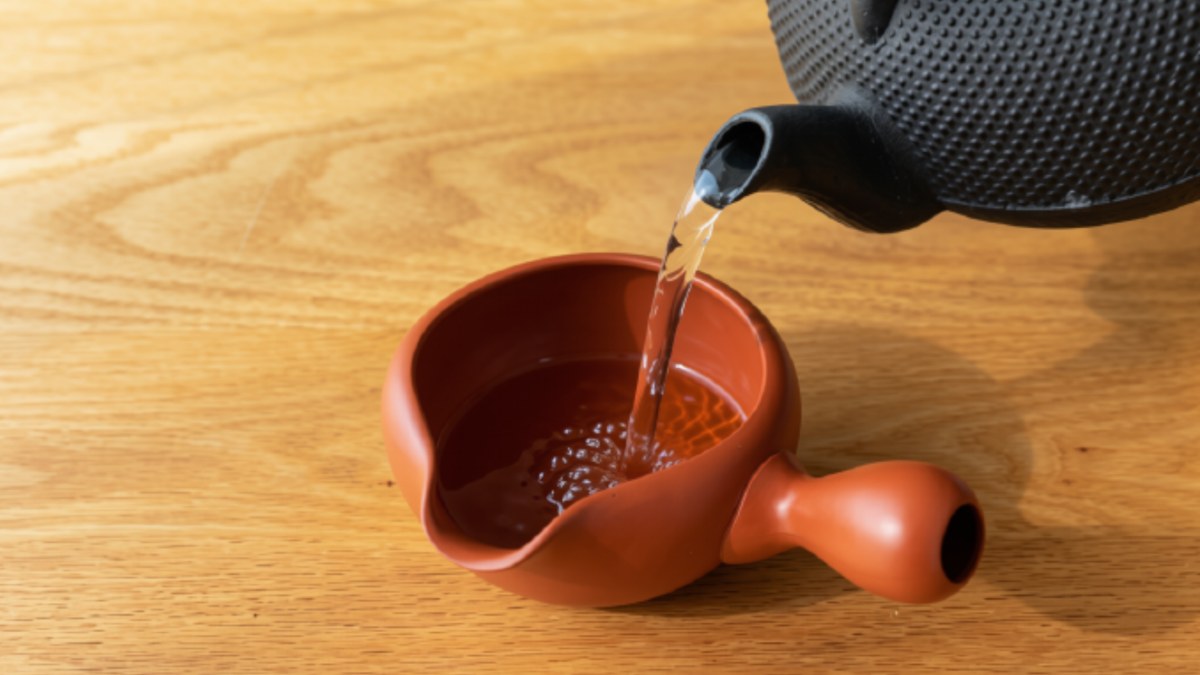
A yuzamashi (湯冷まし) is a small open vessel whose only job is to cool water. That is the whole design brief. No lid, no filter, no mechanism — just a wide, shallow bowl with a lip, made to be poured into and then poured out of.
Here is why a whole object exists for this. Boiling water leaves your kettle at 100°C. Sencha wants roughly 70–80°C. Gyokuro, the shaded tea, wants 50–60°C — barely warm to the touch. Only the roasted teas, hojicha and bancha, are happy with water straight off the boil.
Pouring hot water from one room-temperature vessel into another drops it by roughly 10°C. The wide, shallow shape is what makes that work: more surface area, faster loss. So kettle to yuzamashi to kyusu is two transfers, about 20°C, and you arrive near 80°C. That is how a Japanese household hits the right temperature every morning without ever owning a thermometer.
You do not need to buy one. Any second cup does the same thing. But if you fix only one habit in this entire article, fix this one.
There is a second reason to cool your water, and it has nothing to do with flavour. In 2016 the International Agency for Research on Cancer classified drinking beverages hotter than 65°C as probably carcinogenic to humans, based on evidence linking very hot drinks to cancer of the oesophagus. That finding is about temperature, not about tea — coffee and soup carry the same caution. It is worth knowing that Japanese tea practice built the habit of cooling into every step long before anyone measured why it mattered.
I find this one genuinely interesting, because the tradition and the evidence arrived from opposite directions and met in the same place. Nobody in Edo-period Japan was thinking about the oesophagus. They cooled the water because hot water made the tea bitter, and they built a whole small object to do it. Centuries later the epidemiology arrives and says: yes, and also, don’t drink anything above 65°C. My own field is full of practices like this — habits that persisted because they worked, long before anyone could say why. That is not a reason to accept every old practice uncritically. It is a reason to check them properly, because some of them turn out to be right.
Your Tea Is Going Stale: The Chazutsu
Green tea has four enemies, and most kitchens supply all four at once: oxygen, light, warmth, and moisture. There is a fifth that catches people out — odour. Tea leaf is dry and porous, and it will take on the smell of whatever it lives next to. A packet stored beside the coffee will taste faintly of coffee within a fortnight.
The Japanese answer is the chazutsu (茶筒), the tea caddy. The good ones are double-lidded: an inner lid that sinks slowly under its own weight and seals against the wall, and an outer lid over it. Some are wrapped in polished cherry bark, a craft called kabazaiku from Kakunodate in Akita, which happens to regulate humidity as well as it looks. But the principle is what matters, not the object. Any genuinely airtight tin, kept in a dark cupboard away from the spice rack, does the work.
One thing worth getting right: do not keep an opened packet of green tea in the refrigerator. Every time you take it out, the cold leaf pulls condensation from the room air, and moisture is the fastest way to flatten it. Unopened tea can be refrigerated or frozen, but let the sealed packet return to room temperature before you open it.
The Pot: The Kyusu
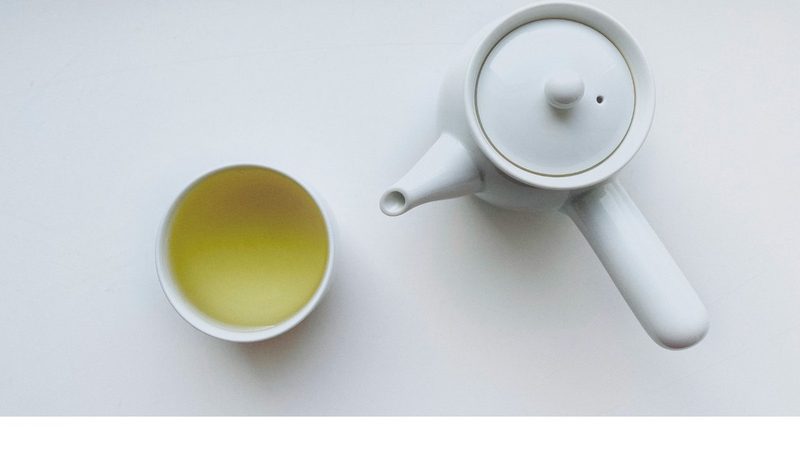
Now the teapot. The problem a kyusu solves is narrow: hold the leaf while the water works, then separate leaf from liquid completely and quickly, without crushing anything.
The part that decides whether it does that well is the mesh. Japanese sencha is often fukamushi — deep-steamed — which breaks the leaf into fine particles that a coarse strainer lets straight through into your cup. A fine ceramic mesh built into the pot wall handles them; a cheap metal basket does not.
The side handle, set at right angles to the spout, is the standard Japanese form. It is not a stylistic choice. It lets you lift, pour and set down with one hand while the other stays free, and it makes it easy to pour out the very last drop — which matters, because tea left sitting on the leaf keeps extracting and turns bitter by the second steep.
You will read that the iron-rich red clay of Tokoname reacts with tannin and softens astringency. That claim is old and widely repeated in Japan, and there is something to it, but I would be careful about how much weight to give it. Choose a pot for its mesh, its size and how it pours. Treat any effect from the clay as a bonus rather than a reason.
→ How to choose a kyusu: handle types, mesh, clay, and the size that actually suits your kitchen
The Cup: The Yunomi
The cup is the piece nobody explains, and it does more than it looks like it does.
A yunomi (湯呑) has no handle. From outside Japan that reads as an omission. It is the opposite: it means your hands meet the temperature before your mouth does. If the cup is too hot to hold comfortably, the tea inside it is too hot to drink — and given what we know about 65°C, that is a useful thing to be told by the object itself rather than by your throat.
Wall thickness does the rest. A thick-walled cup conducts heat to your lip slowly, so you can drink sooner and the tea stays warm longer. A thin-walled cup does the reverse, which is why the small, fine cups used for gyokuro suit a tea served at 50°C in tiny amounts — you want to feel it, not be shielded from it.
Shape steers the aroma. A tall, narrow cup holds heat and funnels the smell upward, which suits sencha and hojicha. A wide, open cup lets it go — fine for something you are drinking in volume, wasteful for something you paid for.
For Matcha: The Chawan and the Chasen
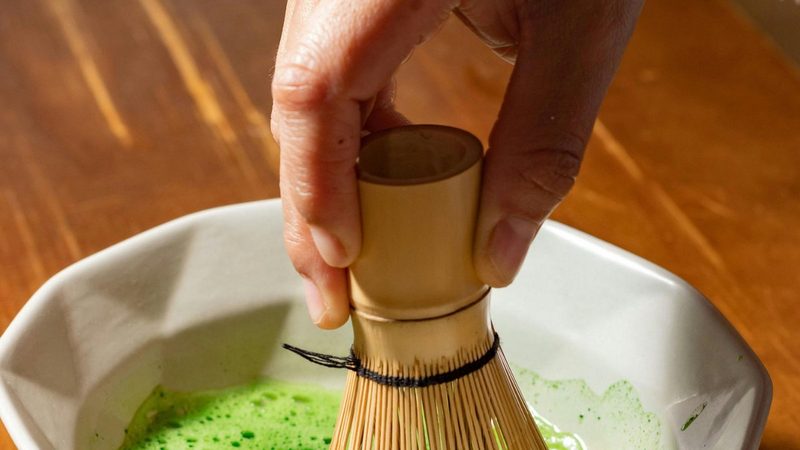
Matcha is a different problem, because you are not separating anything. The leaf is already powder, and it stays in the bowl. What you need instead is to break up the clumps and drive air into the liquid.
That is why a chawan is wide — usually 11 to 13cm across — with a flat interior floor rather than a rounded one. The whisk has to travel in a straight line and clear the base. A rounded bowl or a mug fights you the whole way, and no amount of technique compensates.
The chasen, the whisk, is cut from a single piece of bamboo into 80, 100 or 120 prongs. More prongs make a finer, denser foam. For everyday thin matcha, 80 to 100 is plenty. It is a consumable, not an heirloom — prongs break, and a whisk that has lost several stops working properly.
→ Choosing your first matcha bowl and whisk: sizes, prong counts, and what to skip
The Water Itself: The Tetsubin
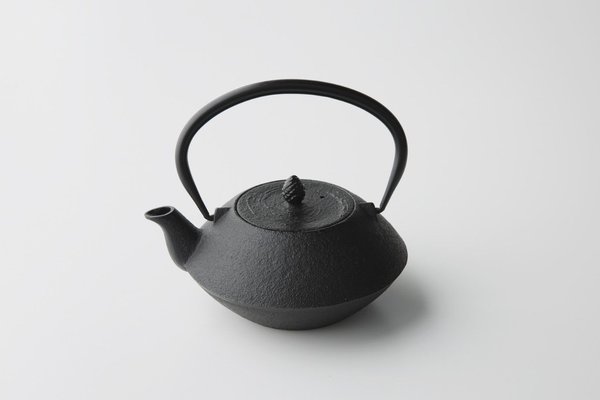
A tetsubin is an iron kettle for boiling water. It is the piece most often misunderstood abroad, so it is worth being blunt about two things.
First: a tetsubin boils water. It does not brew tea. Tannin from the leaf reacts with iron and leaves a dark residue, and in a raw-iron kettle it damages the interior surface that keeps rust away. Boil in the tetsubin, then brew in the kyusu.
Second: most cast iron “teapots” sold outside Japan are enamel-lined. Those are safe to brew in, and they are easy to look after — but the lining means the water never touches iron, so they do none of what a tetsubin is actually for. Only unlined raw iron puts iron into the water, and that is the entire point of the object.
Whether you can taste the difference is a fair question, and the honest answer is that it is subtle. Water boiled in raw iron is generally described as rounder and softer. It is a real effect, but it is the last refinement, not the first.
→ The Nambu tetsubin: raw iron against enamel, how it is cast, and how to keep one from rusting
Keeping Them Alive
Japanese tea ware is not fragile, but it is specific. Most of it is ruined by ordinary kitchen habits rather than by accidents.
No detergent on unglazed clay. The body is porous. Soap goes in, stays in, and comes back out into your next cup. Hot water is enough — tea leaves nothing behind that needs stripping.
Empty the leaves straight away. Leaf left sitting in a warm damp pot is how a kyusu starts to smell. Tip it out as soon as you have poured, rinse, and leave the pot upside down with the lid off until it is dry through.
Never scrub a mesh with metal. A fine ceramic mesh is the most valuable part of the pot and the easiest to destroy. Hot water and a soft brush.
Dry a tetsubin with its own heat. Empty it while it is still hot and the residual warmth drives off the last of the water. Leave the pale scale that builds inside alone — it protects the iron.
A chasen needs to keep its shape. Rinse it in warm water, never soap, and store it over a kusenaoshi, the ceramic dome that holds the prongs open as they dry.
What I Would Actually Buy, and in What Order
This is the part the other guides skip, so here it is plainly.
First, nothing. Turn the kettle off before it boils, or pour the water into a second cup and wait two minutes. Move your tea into any sealed container you already own. That is the two biggest problems solved for free, and until they are solved nothing else you buy will show its worth.
Then a kyusu. 200–300ml, fine mesh, side handle. This is the first thing genuinely worth spending on.
Then cups. Two yunomi. Tea is better with someone else there.
Then a proper tin, if the one you improvised is not truly airtight.
Then a yuzamashi, once pouring between cups starts to feel like a nuisance.
A chawan and chasen only if you drink matcha. They do nothing for leaf tea.
A tetsubin last. It is a lifetime object and it deserves to be chosen slowly, not bought first because it photographs well.
Frequently Asked Questions
What Japanese tea ware do I actually need to start?
Less than most guides suggest. To brew Japanese green tea well you need a way to cool the water below boiling, an airtight container to keep the tea fresh, and a pot with a fine mesh. The first of those costs nothing — pour the water into a second cup and wait two minutes. A kyusu of 200–300ml with a fine mesh is the first thing genuinely worth buying.
What is a yuzamashi, and do I need one?
A yuzamashi is a small open vessel whose only job is to cool water. Pouring hot water from one room-temperature vessel into another drops it by roughly 10°C, so kettle to yuzamashi to kyusu lands you near 80°C without a thermometer. You do not need one — any second cup does the same thing — but it is the cheapest way to fix the single biggest cause of bitter Japanese tea.
Can I brew tea inside a tetsubin?
No. A tetsubin is for boiling water, not for brewing. Tannin from the leaf reacts with iron and leaves a dark residue, and in an unlined tetsubin it damages the interior surface that prevents rust. Boil the water in the tetsubin, then brew in a kyusu. The teapot-shaped cast iron pots sold abroad with an enamel lining are a different object — those are safe to brew in, but they do not change the water.
How should I clean a Japanese teapot?
With hot water only. Unglazed clay is porous, so detergent soaks into the body and you will taste it in the next cup. Empty the leaves as soon as you have finished pouring, rinse the pot and the mesh with hot water, then leave it upside down with the lid off until it is completely dry. Never scrub the mesh with anything metal.
How should I store green tea at home?
Airtight, cool, dark, and away from anything that smells. Green tea is unfermented, so it oxidises quickly, and it absorbs odour readily — a bag left beside the coffee will taste of coffee. Move it out of its original bag into a sealed tin. Do not keep an opened packet in the fridge: every time you take it out, condensation forms on the leaf.