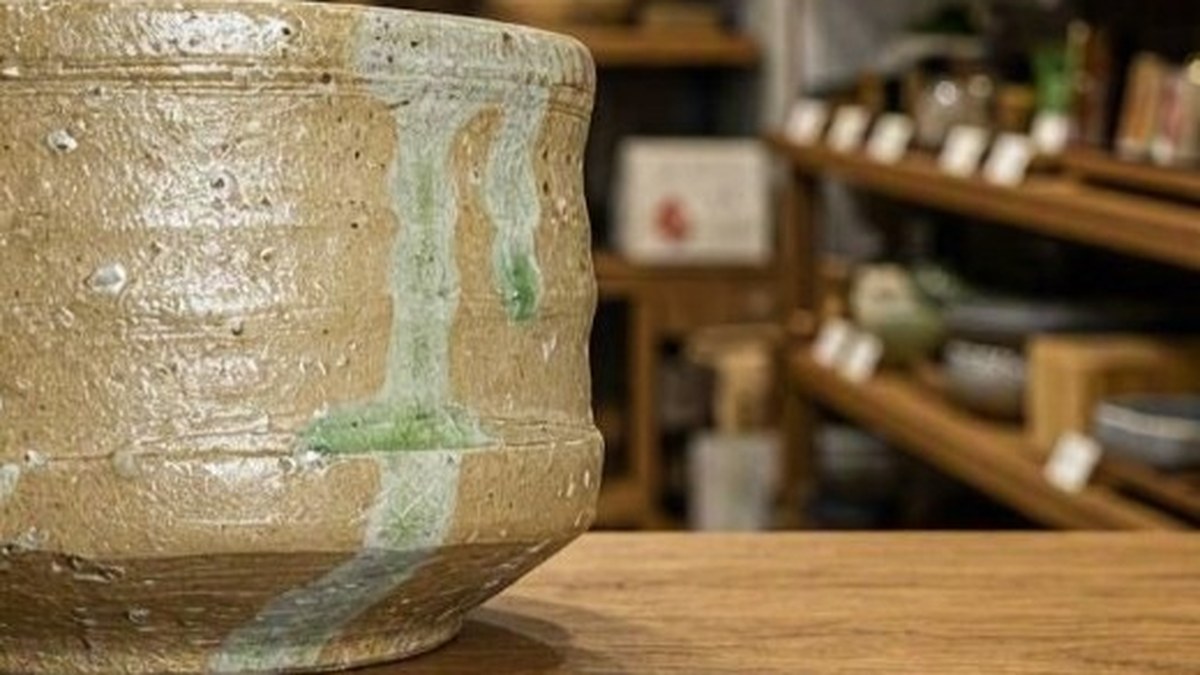
Pick up a piece of unglazed Shigaraki and you are holding three separate events, all of which happened in the same three or four days, none of which anyone chose.
The white grains standing proud of the surface. The green glass running down one side. The black at the foot. Shop descriptions name them — hi-iro, bīdoro, koge — and then stop, as though naming were explaining.
Each one has a mechanism, and the mechanisms are different from each other. One is the clay pushing outwards. One is fuel becoming glass. One is the absence of oxygen. This article is about which is which.
→ For the town, its history and what to buy, start with Shigaraki ware: the kiln that tea masters redesigned.
The Clay Is Full of Rocks, and That Is the Point
Shigaraki clay comes from the hills around Lake Biwa, and geologically it is old lake-bed sediment: weathered granite that washed down, settled, and stayed. Granite is quartz, feldspar and mica. The feldspar and quartz never fully broke down.
So the clay arrives with hard grains already in it. Most potteries would wash them out. In Shigaraki they are left.
What happens in the kiln is a difference in behaviour between the grains and the body around them. The clay body shrinks as it fires — water leaves, then chemically bound water, then the particles pull together. Quartz and feldspar do not shrink the same way; quartz actually expands as it passes through a change in its crystal structure at around 573°C.
The body contracts. The grains do not. So the grains end up standing out of a surface that has pulled away from them, sometimes tearing the skin around themselves as they go.
Feldspar has one more trick. It melts at a lower temperature than the clay body does, so at the top of a firing the exposed grains soften and go slightly glassy at their tips — which is why on a good piece they read as white and wet rather than white and chalky.
Bīdoro: The Kiln Makes a Glaze Out of Its Own Fuel
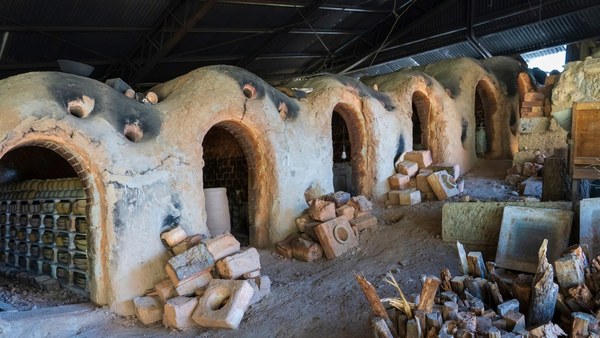
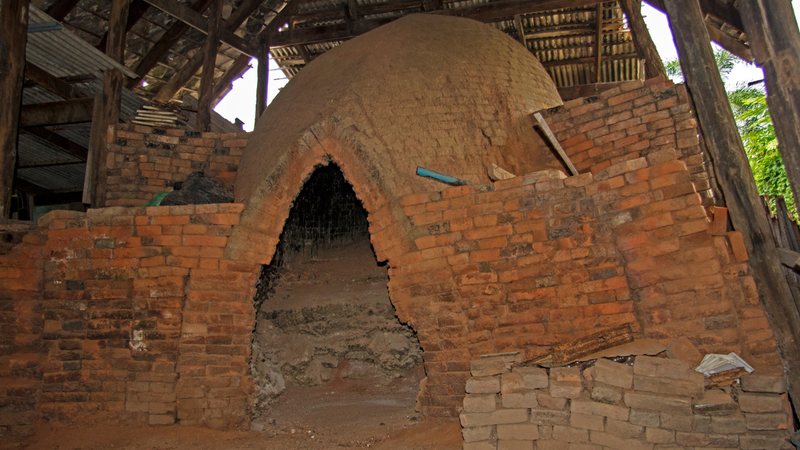
A wood kiln burns for days. Red pine at temperature does not simply produce heat — it produces fly ash, and the draught carries that ash through the chamber and lays it down on everything inside.
Wood ash is largely calcium, potassium and silica. Calcium and potassium are fluxes: they lower the temperature at which silica will melt. Ash sitting on a pot at 1250°C is therefore not just dust. It is most of a glaze recipe, missing only the silica — and the pot is made of silica.
Above roughly 1200°C the ash and the surface of the clay begin to react. They form a glass. It flows.
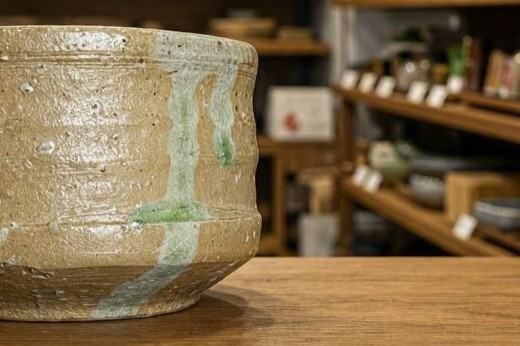
The green comes from iron. Shigaraki clay contains a small amount of it, and iron dissolved into a glass in an oxygen-poor atmosphere reads as green rather than brown.
Everything about how bīdoro looks follows from the fact that ash falls. It gathers on shoulders and rims and horizontal ledges. It runs down and stops where it cools. The side facing the firebox gets a great deal; the side turned away gets almost none. A pot with an even coat of green did not get it from a kiln.
Koge: Where the Fire Ran Out of Air
By the end of a long firing, the floor of the chamber is deep in embers and ash. Pots standing in it are partly buried.
Buried clay is in a different chemical situation from clay in the open. Oxygen cannot reach it, but the burning charcoal around it desperately wants oxygen — and it takes it from wherever it can, including from the iron oxide in the clay body itself.
Iron in an oxygen-rich fire stays as ferric oxide and reads red-orange. Iron stripped of oxygen becomes ferrous, and reads grey-black to brown. That is the whole of it. The dark foot of a Shigaraki pot is iron that had its oxygen taken away.
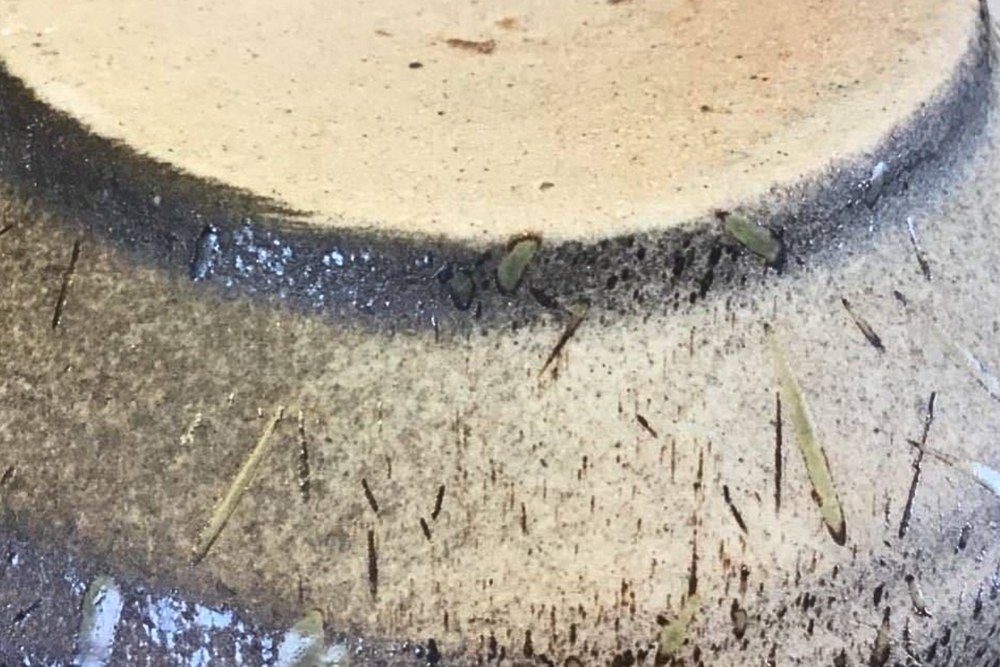
The picture above carries something else worth naming. Those fine, hair-thin marks are straw. Pots are stacked with straw between them so they do not fuse; the straw burns off in the first hours, and where it lay, the clay takes a different colour. It is the same principle as the straw marks on Bizen ware.
So a single foot can record three things at once: what was buried, what was resting on the shelf, and what was touching it.
Hi-iro: The Ordinary Case
The warm orange-red of a Shigaraki surface is the least mysterious of the three, and it is worth saying so.
It is iron in the clay, oxidised. Where flame passes over a surface with plenty of air, the iron takes up oxygen and reads orange to red. Hi-iro is what the clay does when nothing unusual happens to it — and koge is what the same clay does when oxygen is taken away.
The two are not different materials. They are the same iron, in two different atmospheres, a few centimetres apart.
Why the Same Pot Has All Three
Here is what makes an unglazed Shigaraki piece worth turning over in your hands.
A pot standing on a kiln shelf, mid-chamber, will typically have ash landing on its upper surfaces, flame washing its exposed side, and its foot in the embers. Three different conditions, on one object, at the same moment.
So you get green glass at the shoulder, orange along the flank, and black at the base — not as a design, but because those parts of the pot were in different places relative to the fire.
Which is why the first thing worth doing with any wood-fired piece is to rotate it slowly. Somewhere on it is the side that faced the fire. Once you can see that, the surface stops being a pattern and becomes a record of an orientation.
What This Means When You Buy One
Even coverage is the tell. Ash falls from above and runs downwards. If green is distributed evenly all round, or if it is as strong inside as out, it was applied rather than landed.
Check the boundary. A natural ash glaze fades out where the ash thinned. A dipped glaze stops at a line.
Check the foot. Dark scorching means the piece sat in ash in a wood kiln. A clean, even foot means an electric one. Both make good pots; only one carries a record.
And be relaxed about the grains. Feldspar standing out of the surface, sometimes with the skin torn around it, is not a flaw and is not a sign of carelessness. It is the specific characteristic tea masters wanted from this town in the sixteenth century, and it is why they went to Shigaraki rather than somewhere smoother.
Frequently Asked Questions
Why does Shigaraki pottery have white specks?
They are grains of feldspar and quartz in the local clay, which is weathered granite sediment from around Lake Biwa. The clay body shrinks as it fires while the hard grains do not, so the grains end up standing out of a surface that has pulled away from them. Feldspar also melts at a lower temperature than the body, so the exposed tips go slightly glassy, which is why they read white and wet rather than chalky.
What is bīdoro and how does it form?
The glassy green that runs down a wood-fired piece. Burning red pine produces fly ash that the draught carries through the kiln and deposits on the pots. Wood ash is rich in calcium and potassium, which lower the melting point of silica — and the pot is made of silica. Above about 1200°C the ash and the clay surface react and form a glass, which then runs downwards. The green colour comes from iron in the clay.
Why is the bottom of Shigaraki pottery black?
Because it was buried in embers. Charcoal starved of air takes oxygen from anywhere it can, including the iron oxide in the clay. Iron with its oxygen removed reads grey-black to brown, while iron in an oxygen-rich part of the same kiln reads orange-red. The dark foot and the warm body are the same iron in two different atmospheres, a few centimetres apart.
Can you tell a wood-fired piece from an electric-kiln one?
Usually, and quickly. Ash falls from above and runs down, so a natural glaze is heavier on the upper surfaces and on the side that faced the fire, and it fades out rather than stopping at a line. An even coat all round, or a glaze as strong inside as out, indicates it was applied. The most reliable check is the foot: dark scorching means the piece stood in ash.
What are the fine line marks on some Shigaraki pieces?
Straw. Pieces are stacked with straw between them so they do not fuse together during firing. The straw burns away in the first hours, and where it lay the clay takes a different colour, leaving hair-thin marks across the surface. It is the same principle as the straw-wrapped markings on Bizen ware.