If you own one good Japanese teapot, there is a fair chance it came from a town most people outside Japan have never heard of — and which many of them have already stood in without noticing.
Tokoname sits on the Chita peninsula in Aichi, on the bay south of Nagoya. It is the largest and oldest of Japan's Six Ancient Kilns, and it has been firing clay continuously for something close to a thousand years. It is also, for the last century and a half, where the Japanese teapot comes from.
→ The teapot itself, and how to choose one: how to choose a kyusu. For where the pot sits among everything else you might buy, see the guide to Japanese tea ware.
A Town That Made Pipes
Here is the part that surprises people. Tokoname did not become the teapot town by way of refinement. It became the teapot town because it was an industrial one.
For most of its history Tokoname made large, plain, useful things: storage jars, sutra containers, roof tiles. Then in the Meiji era it made an enormous quantity of clay sewer pipes — the first large order came in 1872, for the new reclaimed land at Yokohama — along with tiles, flowerpots and braziers. For decades, pipes were the town's main product, not teapots.
What that gave Tokoname was a thousand years of practice at one specific thing: firing local clay hard, without glaze, and having it come out dense, watertight and consistent. That is not a decorative skill. It is an industrial one. And it happens to be exactly what a good teapot needs.
Where the Shape Came From
The Japanese teapot as we know it has a documented starting point, and it is more recent than most people assume.
In the early 1860s a Tokoname potter named Sugie Jumon made the first shudei — red clay — teapots in the form that modern kyusu still follow. Then in 1878 a local industrialist, Koie Hoju, heard that a Chinese scholar living in Nagoya knew the teapot-making methods of Yixing, the town in Jiangsu that had been producing purple-clay teapots for centuries. He invited the man — Jin Shiheng — to Tokoname and had him teach the local potters directly.
What Jin taught was the Yixing method of building a pot from paddled slabs of clay rather than throwing it whole. Sugie Jumon's workshop and the fourth-generation Ina Chōzō were among those who learned it. It is worth saying plainly: the Japanese kyusu owes part of its technique to a Chinese teacher, by invitation, and Tokoname has never pretended otherwise. The town's own museum records it as one of the defining events in its history.
Mass production followed much later. It was not until the 1950s, with mould-based manufacturing and the town's sea access, that Tokoname became the source of most of Japan's teapots.
The Part You Actually Hold: the Strainer
Ask which single feature separates a Tokoname kyusu from a generic teapot and the answer is not the clay. It is the filter.
A Tokoname pot's strainer is not a basket dropped inside it. It is built into the wall of the pot itself — a field of fine holes, or a band of narrow slits called sasame, formed in the clay behind the spout. Nothing is inserted, nothing comes out to be washed separately, and nothing crushes the leaf.
This matters more with Japanese tea than with any other. Much Japanese sencha is fukamushi, steamed longer, which breaks the leaf into fine particles. A coarse metal basket lets those particles straight through into the cup; a fine ceramic mesh holds them back while the liquid passes. A pot that cannot do this will give you cloudy, gritty tea no matter what leaf you put in it.
It is also the part that determines whether a pot is worth its price. Making a mesh of a hundred and fifty fine holes in soft clay, positioned so it does not clog, is slow skilled work. It is the reason a hand-made kyusu costs what it does, and the reason a cheap one disappoints.
The Red Clay
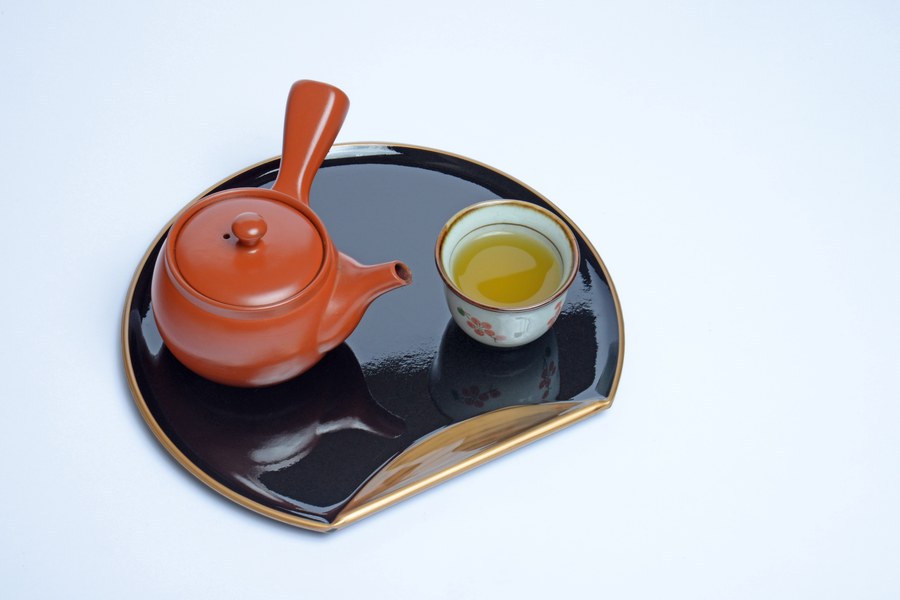
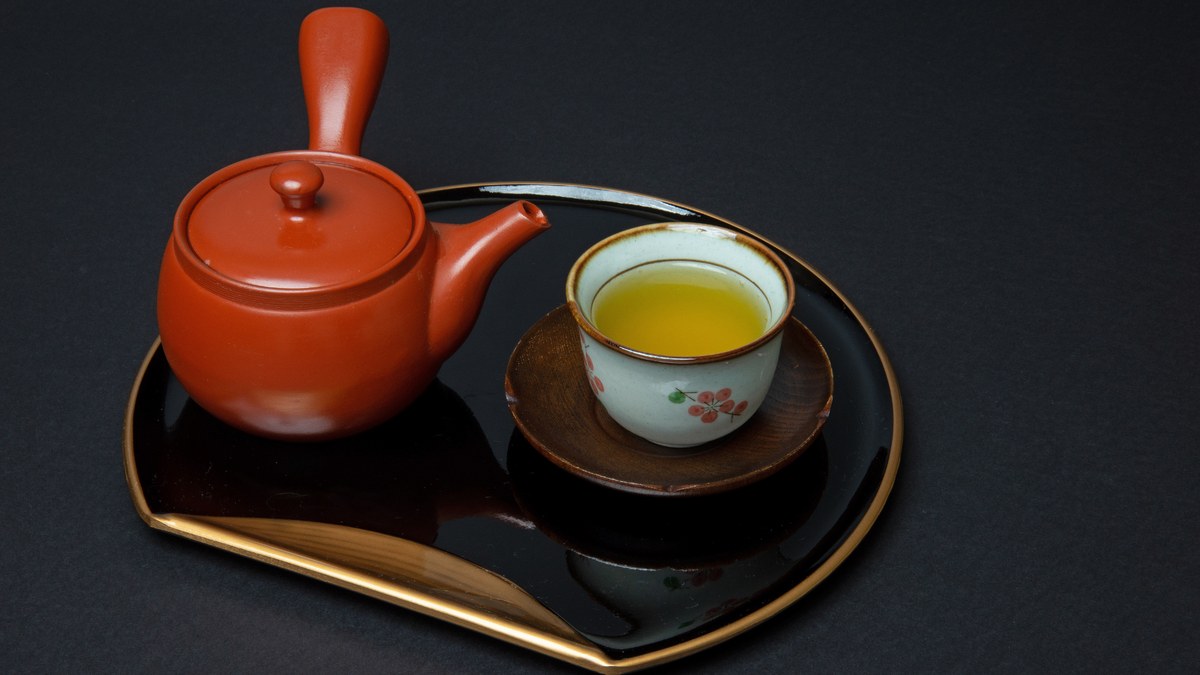
Shudei (朱泥) means vermilion clay. Tokoname's local earth is unusually rich in iron oxide and unusually plastic, and when it is fired unglazed in an oxygen-rich atmosphere the iron turns it a warm reddish brown. Fired hard, it becomes stoneware: dense, watertight, and slowly developing a soft sheen with years of use.
You will read everywhere — on shop pages, in guidebooks, in most English articles about Tokoname, and in the section on Tokoname in my own article about the Six Ancient Kilns — that the iron in this clay reacts with tannins in the tea and rounds off the bitterness.
I am not going to repeat that claim here without examining it. It is the single most repeated statement about Tokoname ware in English, and almost nobody who repeats it has looked at where it comes from or how large the effect is supposed to be. That deserves its own article rather than a confident sentence in this one, so I went and looked.
What I can say without hesitation is the part that does not depend on chemistry: an unglazed pot is porous, and porosity means the pot takes on the character of what you brew in it. Use one pot for sencha and only sencha, for a few years, and it becomes a pot that makes that tea slightly better than it did when new. That much is not disputed by anyone.
A Living National Treasure, for a Teapot
In 1998 the Japanese government designated Yamada Jōzan III a holder of Important Intangible Cultural Property — a Living National Treasure — in the category Tokoname ware (kyusu).
Read that category again. Not ceramics. Not tea ware. Teapots. Japan gave its highest craft designation to a man for the making of one object, and it is worth pausing on what that says about how seriously the country takes the thing sitting on your counter.
Jōzan was born in Tokoname in 1924, trained under his grandfather and father, and by the end of his life had made something over a hundred distinct teapot forms. He also founded the town's Handmade Kyusu Association, at a moment when moulded mass production was rapidly making handwork uneconomic. He died in 2005.
How to Live With One
An unglazed Tokoname pot asks for very little, but it asks specifically.
Water only. Porous clay absorbs detergent and gives it back into your tea for weeks. There is nothing in tea that needs a solvent.
One pot, one tea. The same porosity that makes the pot improve with sencha will make it taste faintly of hojicha if you alternate. Pick a lane.
Empty and dry it immediately. Leaves left sitting in a warm damp pot are how a good kyusu starts to smell, and the smell goes into the clay.
→ The full routine, and the three things that ruin clay, iron and bamboo: how to clean Japanese tea ware.
You Have Probably Already Been There
Here is the practical note that no English guide seems to make.
Chubu Centrair International Airport — Nagoya's international airport — is in Tokoname. It sits on an artificial island off the city's coast. If you have flown into central Japan, you landed in the teapot town.
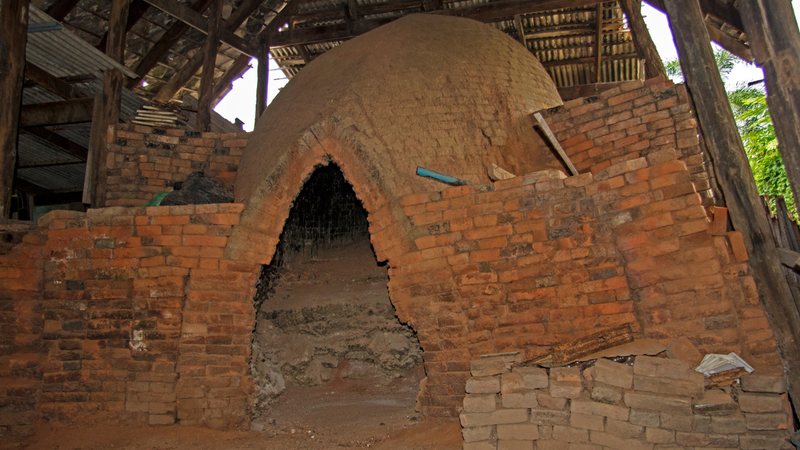
The old pottery district is roughly fifteen minutes from the airport by train, and it is genuinely worth the detour on a layover. The walk to take is the Yakimono Sanpomichi, the Pottery Footpath: a loop through the old kiln quarter where the retaining walls are built from stacked clay sewer pipes and shōchū bottles — the town's industrial leftovers, used as masonry. There is a surviving climbing kiln from 1887 with ten chimneys, now a protected cultural property. It takes about two hours at an unhurried pace.
One more thing, because it will confuse you otherwise: Tokoname is also Japan's largest producer of maneki-neko, the beckoning cat. There is a street lined with them and a very large cat head watching the road. It has nothing to do with tea. It is simply what happens to a town that has been good at clay for a thousand years.
Frequently Asked Questions
What is Tokoname ware?
Pottery from Tokoname in Aichi Prefecture, the largest and oldest of Japan's Six Ancient Kilns, with roughly a thousand years of continuous production. Historically it made storage jars, roof tiles and clay sewer pipes; since the late nineteenth century it has been the main source of Japan's teapots. Its best-known form is the unglazed reddish shudei kyusu.
Why are Japanese teapots made in Tokoname?
Because the town spent centuries learning to fire local clay hard and unglazed so that it came out dense and watertight — a skill developed for jars, tiles and drainage pipes rather than for tea. That is exactly what a teapot needs. The modern kyusu form was established there in the 1860s, refined after Yixing techniques were taught locally in 1878, and mass production followed in the 1950s.
What makes a Tokoname kyusu different from an ordinary teapot?
The strainer. Instead of a metal basket dropped inside, the filter is formed directly in the wall of the pot as a field of fine holes or narrow slits. It holds back the fine particles of deep-steamed Japanese sencha, which a coarse basket lets through, and it does not crush the leaf. Making one by hand is slow, skilled work, and it is most of what you are paying for.
Does Tokoname's red clay really make tea taste better?
The standard claim is that iron in the clay reacts with tannins and softens bitterness. It is repeated almost everywhere, and it deserves a closer look than a single sentence — that is the subject of a separate article. What is not in dispute is that an unglazed pot is porous, so a pot used for one tea over several years does come to suit that tea.
Can you visit Tokoname?
Easily. Nagoya's international airport, Chubu Centrair, is in Tokoname itself, and the old pottery district is about fifteen minutes away by train. The Pottery Footpath takes roughly two hours and passes walls built from stacked clay pipes and bottles, and a preserved ten-chimney climbing kiln from 1887. It is a realistic layover excursion.